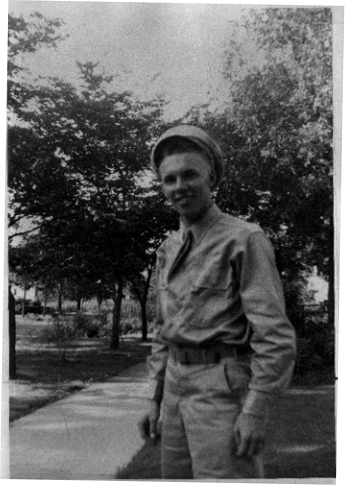
by Harold J. Matson
I was still in high school when Pearl Harbor was attacked in December, 1941. I graduated in June, 1942, and went to work at Poster Products in Chicago. Because of the war effort, the company was converted to tent manufacturing.
In the fall of 1942, I enrolled at the University of Illinois-Champaign in chemical engineering. I attended one semester before returning back to Poster Products where I became a foreman.
In the summer of 1943, I tried to enlist in the Air Corps and the Navy but was turned down because of color-blindness. Shortly thereafter, my draft number came up and even though I could have received a deferment from Poster Products, I was inducted into the Army at Fort Sheridan. In August, I was sent to Camp Swift, Texas, where the 86th was in the process of being formed, for basic training.
From August, 1943, until about February, 1944, I was in basic training with the 4.2 mortar. The curriculum was easy as well as fun for me; I could not understand why many other recruits were not happy. I became “town-buddies” with Sauer, Kayo, Stahler, McKenzie, and Dontou.
I think it was late March of 1944 that the 86th shipped out as a unit, via train, with jeeps, guns, and trucks amidst rumors that we were headed for North Africa. We disembarked the train in New Jersey and spent several days training there. Our training included evacuation from ship procedures should the ship sink or even worse happen.
Next we loaded the equipment and boarded the New Amsterdam luxury liner and were told we were headed for Scotland. The ship travelled solo, in a zig-zag pattern, for 5 days. We landed in Scotland at a beautiful harbor. We then convoyed south to England and quiet, peaceful Port Sunlight. It was not far from Liverpool, but we generally took our overnight passes to New Brighton, a summer resort on the nearby coast.
During April and May of 1944, we were billeted in private homes in Port Sunlight. Some fellows were two to a family; I was a single. I stayed with an older couple in their son’s second floor bedroom. (Their son was away in the service.) During this time in Port Sunlight we had scarcely any duties to perform. We had roll call in the town square and a few classes. It was here we learned to drink warm beer. We had only one bivouac for a practice firing mission into Wales. There we found a rolling countryside, rather barren, but with character.
In early June, 1944, we convoyed to southern England to Salisbury Plain where we set up camp for a couple of weeks expecting to be called for the invasion. We did nothing but play ball and keep fit. About June 9th or 10th we loaded our equipment at Southhampton, and Company B boarded the Liberty Ship, the “James A. Farrell”. We were with another reconnaissance group in a huge convoy to cross the English Channel. After noticing several other ships sinking, we were suddenly hit by a torpedo. The stern immediately went down and we were ordered to abandon ship. The British crew seemed to panic. An LST returning empty to England pulled alongside and we abandoned our ship by jumping from ours to theirs. We were taken to the luxury Brighton Hotel in England where we were re-outfitted. We returned as a unit to Cherbourg, France in late June to re-join the rest of the 86th Battalion.
During June and July we participated in hedgerow fighting in Normandy. We broke through at St. Lo and were sent south to the Brest Peninsula where we participated in the siege of the city with its submarine bases.
In the fall of 1944, we convoyed across France to the Eastern Front where we got smashed by heavy artillery while still several miles from the front. We re-grouped and spent the next few weeks on hit-and-run missions in support of various infantry units heading toward Aachen, Germany, or so we were told.
In late November, 1944, we moved into Hurtgen Forest where we were stalemated for a month in one place. We were in a small valley, and we were miserable, cold, wet, muddy, and under fire. There we were brought Thanksgiving dinner. During this time I buddied with Zeke McKenzie and his humor made light of everything. Shortly thereafter, our tanks broke through and we followed them several miles into the village of Hurtgen.
It was the 2nd week of December, and the first day after setting up mortars in backyards, when an explosion knocked me down into the hole where we had set up our guns. At first I thought it was a muzzle burst of our own gun, but I found out it was from an incoming shell and the concussion had knocked me down. Our gun sergeant Sgt. Horn helped me out from under our mortar, but when I tried to stand, my leg collapsed. (I thought it was broken.) I was carried into the cellar of the house in whose backyard we had set up the guns. The next morning I was taken by jeep to an aid station in town where an army doctor examined me and sent me by ambulance to a tent field hospital (probably a mile or two back) where I received the Purple Heart. Ironically, I had possibly helped in the manufacture of that tent back at Poster Products.
The second or third day after I arrived, we were forced to evacuate the hospital because the German tanks were coming through. We found out later that this was the beginning of the Battle of the Bulge. I was taken by ambulance to Verviers, Belgium, where a temporary hospital had been set up in a school. I then begin a trip through the chain of Army hospitals: by ambulance to Paris; train to some French coast port (possibly Cherbourg); medical ship across the channel to northern England some place (Here a high school buddy of mine came to visit me—what a surprise!); then on the Queen Mary to the U.S. (New Jersey I think); by train to Memphis, Tennessee; and then train to Battle Creek, Michigan, where I received a medical discharge at Percy Jones General Hospital in June, 1945.
*Postscript as contributed by
Barb Cooper, daughter of Harold Matson:
In the urgency of evacuation, someone handed my dad a Purple Heart medal. In spite of that fact, the medal was never acknowledged on his discharge papers. On February 18, 2009, after 2 years of navigating a maze of bureaucracy, the records were finally corrected and my dad received a package in the mail from the Department of the Army. The package contained the Purple Heart, Good Conduct Medal, Presidential Unit Citation, American Campaign Medal, European-African-Middle Eastern Campaign Medal with 4 bronze service stars, World War II Victory Medal, and Honorable Service Lapel Button WWII.
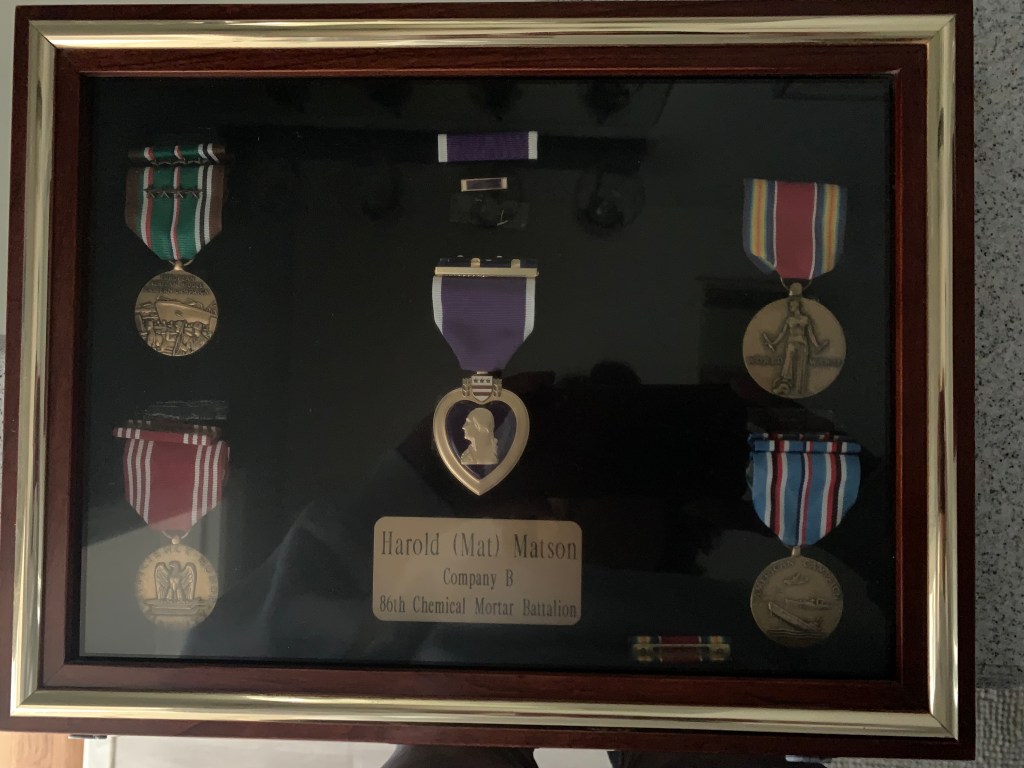
All good things come to those who wait.
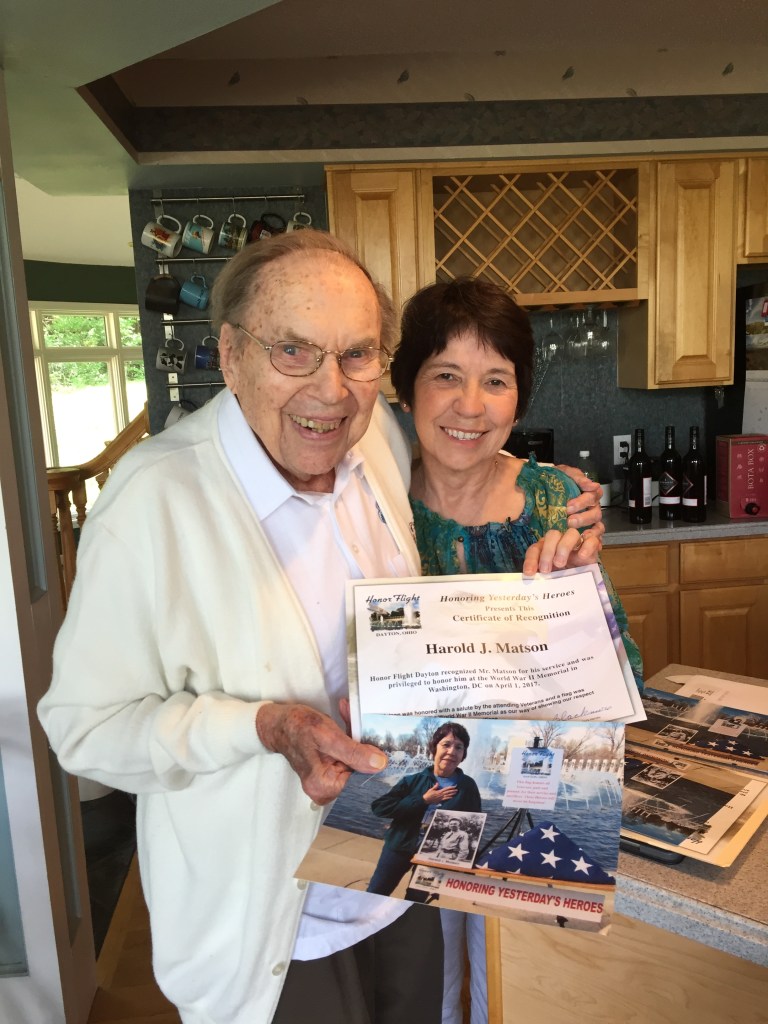
Although Harold J. Matson was never able visit the World War II Memorial in Washington, D.C., a friend Janie Jordan represented him as part of an Honor Flight in 2017. She returned with an official Certificate of Recognition given to those unable to travel to see the site in person. Harold passed away on December 17, 2020 at the age of 96, but he would be pleased to know that others have read and shared his story.
 86th Chemical Mortar Battalion