Excerpt from The Battalion History
To all things a beginning…
Everyone knows of the infantry and the air corps, the tankers and the engineers, the quartermaster and ordnance. And they “know” all about Chemical Warfare: they picture us playing with test tubes in white laboratories, a thousand miles behind the lines, discovering new war gases and atomic bombs.
Some within the Chemical Warfare Service do bring new methods of warfare from their labs, but most of us are ordinary soldiers—very like the infantry and all other troops who fight on the ground, for keeps.
Originally, our mortar was designed for firing chemical shells. Then one day someone discovered that you could fire a TNT-filled shell from the same muzzle—and that day you said goodbye forever to clean labs and pretty colored chemicals, and became a soldier.
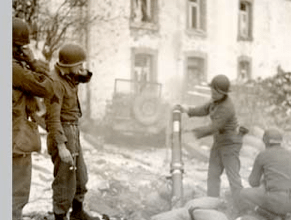
So we toted a 4.2″ mortar from the beaches of France to the heart of fortress Germany. We went where the infantry had to go, a few times arriving before they did. Our ways of life were alike: same wariness by day, same fear by night, same boredom and despair. And some died in the fight—just as the infantrymen.
Neither for the glory nor the medals, the press releases nor the newsreels—but with a vague consciousness we sensed that we had to be a part of this mighty juggernaut that was crushing the Nazis. Beneath our blusters and disdain of flighty words we were proud of being soldiers. We originated a favorite maxim that we used as a “wisecrack” all over Europe—“Don’t fool with the fighting troops!”
Yet there are few—soldiers and civilians alike—who know what a 4.2″ chemical mortar is and what it can do. Here is the answer, and it has nothing to do with chemicals or chemists except in a very abstract way. This is the historical account of a fighting odyssey, the simple facts of where and with whom we fought.
Everyone knows of the infantry and the engineers. This is about mortar men, who also fought a war.
Training
The 86th Chemical Battalion, Motorized, came into being 23 February 1943 when a cadre was formed from the 1st Separate Chemical Company, and station complement personnel declared physically fit for combat. Arriving at Camp Swift, Texas, on 15 May 1943, the cadre immediately undertook preparations for the new-born battalion, and then proceeded in a training program designed to prepare the battalion for close-in support of infantry, the type of missions to be met under combat conditions.
The original battalion commander was Major Richard C. Tanner. On 25 March 1944, Lieutenant Colonel Wesley B. Hamilton assumed command of the 86th and successfully guided its destinies through the Normandy, Northern France, Ardennes, Rhineland, and Central European campaigns.
E.T.O. Bound
Upon completing its short but intensive training program, the battalion departed by rail from Camp Swift on 11 April 1944 for the POE—Camp Shanks, New York. After a hurried three days and nights, the unit left Camp Shanks and boarded the New Amsterdam, a former Dutch luxury-liner now converted to transporting troops. The New Amsterdam sailed from New York harbor on 18 April 1944.
A week later, after an uneventful crossing of the Atlantic, the ship anchored at the scenic port of Greenock, Scotland. It was a pleasure to sight land again, if only because it meant a promise of relief from the crowded shipboard conditions and the not-too-appetizing food.
England
The train which was waiting at the dock took us south into England. By the 27th of April the entire battalion was billeted in private homes of English families located in the village of Port Sunlight, Cheshire. During our two-month visit, we took full advantage of the opportunity and privilege to become really acquainted with our English hosts. The sincerity of the hospitality so graciously offered us, the many little things that made us feel at home, the friendships that developed, will not be soon forgotten.
There was an important job to be done; the unit had to be completely equipped and motorized. Although the time for additional training was short, each company was able to get in one day of firing on the range at Ruabon, Wales, as well as some small arms firing.
The battalion left Port Sunlight on the morning of June 25th and arrived at Stonehenge late at night. At 0300 hours on the 28th, the unit was ordered to proceed to the marshalling area at Southampton immediately.
The battalion sailed for France on the 29th. Early in the afternoon, the convoy ran into a mine field and six ships hit mines. The vessel on which “B” Company had sailed was so severely damaged that personnel were transferred in mid-channel to another boat and returned to the United Kingdom. The other ships reached Utah Beach, Normandy, without further incident.
Normandy Campaign
29 June to 1 August 1944
Units supported :90th Infantry Division; 82nd Airborne Division; 8th Infantry Division; 83rd Infantry Division.
Immediately upon landing, the battalion attached to the Eighth Corps went into combat. During this period the battalion fired more than 11,500 rounds of mortar ammunition in close support of five different divisions and thus assisted materially in the drives which finally resulted in the breakthrough at Avranches by the armor.
On 6 July 1944, all companies underwent a reorganization for the purpose of enabling personnel in excess of platoon T/O strength to be rotated to battalion rear echelon for rest whenever possible. This move was necessary in order to keep men physically fit and equipment in good condition.
Northern France Campaign
25 July to 14 September
St. Malo—Dinard—Cap Frehal—Rennes, 1 to 17 August 1944
Units supported: 79th Infantry Division; 8th Infantry Division; 83rd Infantry Division
During this period the battalion fired a total of 7,844 rounds of mortar ammunition in close support of the infantry troops and contributed to the ultimate capture of St. Malo, Dinard and Cap Frehal. Two officers and two enlisted men of the battalion were in the party of American officials who took the surrender of Colonel von Auloch at the Citadel at St. Malo.
Brest 19 August to 19 September 1944
Units supported: 8th Infantry Division; 29th Infantry Division; 2nd Infantry Division; 2nd Ranger Battalion.
Firing a total of 47,561 rounds of mortar ammunition during the period August 24th to September 19th, the actual dates of the Brest Crozon peninsula fighting, this battalion supplied an extremely high volume of accurate close-in supporting fire, and contributed materially to the fall of Brest and the capture of the Crozon peninsula. It was here that German prisoners of war nicknamed our WP shell “Whispering Death.”
Eastern France 23 September to 22 October 1944
Units supported: 35th Infantry Division; 80th Infantry Division; 4th Armored Division; 26th Infantry Division; 6th Armored Division.
Following the battle of Fortress Brest the battalion was moved to Dombasle, France under the Twelfth Corps. Immediately upon arrival, the mortars were set in position facing the enemy along a line running south from Metz to Luneville.
Ardennes Campaign
16 September 1944 to 25 January 1945
Germany 26 October to 17 December 1944
Units supported: 28th Infantry Division; 78th Infantry Division; 2nd Infantry Division; 99th Infantry Division; 8th Infantry Division.
On the 26th of October, the battalion received word to proceed to Arlon, Belgium. Before the unit was committed here, orders were received sending the battalion to the 28th Infantry Division (Fifth Corps Sector) at Rott, Germany. Here it supported the 28th and its successor in the line, the 8th Infantry Division, in the battle of Hurtgen Forest. This was the only time in the history of the battalion that the unit was committed to the support of just one division. For heroic work in conjunction with the attack on the town of Schmidt and surrounding high ground which protected the network of dams, the battalion received a commendation from the Commanding General of the 28th Infantry Division.
After setting up headquarters in Rott, Germany, it was decided to establish a rest camp, thereby enabling a rotation plan of rest for war-weary men. The town of Dolhain, across the boundary in Belgium, was selected. Daily movies and USO entertainment were features that always gave the fighting man a respite—a rest well-deserved, for this was the period of our hardest (and dirtiest) fighting. On December 1st, the battalion completed its 150th day of combat and fired the 100,000 round of ammunition.
Battle of the Ardennes 17 December 1944 to 16 February 1945
Units supported: 78th Infantry Division; 8th Infantry Division; 2nd Infantry Division; 99th Infantry Division; 1st Infantry Division; 9th Infantry Division; 30th Infantry Division; 82nd AB Division; 75th Infantry Division; 7th Armored Division.
During the Battle of the Ardennes, the battalion proved its capabilities and fighting qualities, assisting in holding the enemy from penetrating our left flank. Time after time, desperate forces of Nazi tanks and fanatical infantry rolled toward our lines. Each time our mortars belched their “Whispering Song of Death.” White phosphorus blinded and burned the Nazis, tank drivers lost their sense of direction and charged crazily into trees, off roads into ditches, into men, and into each other. German foot troops became panicky and vainly sought cover. Finally the enemy offensive lost momentum and began retreating.
In this period the battalion was in support of two Corps and at one time two Armies. At one time the unit supported the Seventh and Fifth Corps, later the Nineteenth Corps of the 9th Army and Fifth Corps of the 1st Army. Later the battalion, under the 1st Army, supported the Fifth Corps and the Eighteenth Airborne Corps. After the enemy all-out drive had been stopped, the battalion was relieved for reorganization and was redesignated the 86th Chemical Mortar Battalion with a Headquarters Company and three Weapons Companies.
Rhineland Campaign
25 January to 21 March
Units supported: 28th Infantry Division; 2nd Infantry Division; 1st Infantry Division; 78th Infantry Division; 104th Infantry Division.
Immediately after reorganization, the battalion supported the Fifth Corps in the final assault on the Roer River defenses and the advance to the Rhine. When the Remagen Bridgehead was established, two companies, A and B, were attached to the Seventh Corps to assist in holding and expanding the bridgehead while preparations for the final breakthrough were being made. As we moved across the Rhineland, Battalion Headquarters was set up in Kalterherber, Munstereifel, and Ahrweiler.
Central Europe Campaign
22 March to 9 May
Units supported: 69th Infantry Division; 9th Armored Division; 3rd TD Group.
During this period, units of the battalion assisted in closing the Ruhr pocket, while the remainder helped in the drive across Germany. Battalion Headquarters displaced several times to keep abreast of the rapidly advancing elements, passing through Neuwied, Weilburg, Trysa, and Wolfhagen. Battalion Headquarters eventually found billets in the city of Naumberg.
“A” Company was supporting the 69th Infantry Division when that unit made the initial contact with elements of the Russian infantry, thereby severing Germany in half and virtually concluding the war.
Since April 7th the entire battalion had been back under Fifth Corps control. On April 28th, all companies were relieved from the line and on May 1st the entire battalion moved to Eschenbach, Germany, assuming a novel phase in its varied experiences—that of security guard, protecting installations and enemy material. It was here that we celebrated V-E Day. Our last move took us across the border into Czechoslovakia to Bischofteinitz in the German Sudetenland.
Conclusion
Leaving Czechoslovakia on June 13, 1945, the battalion went by motor convoy to Camp Lucky Strike, France. We sailed from Le Havre on July 1st headed for home, thirty-day furloughs, and then the Pacific. V-J Day intervened and when the battalion reassembled at Camp Campbell, Kentucky, it was to “sweat out” discharges instead of an invasion of Japan.
From the time the battalion entered combat on June 29th, 1944, until cessation of hostilities in Europe on May 9th, 1945, the unit expended a total of 152,257 rounds of HE and WP ammunition, and was in combat 315 days in the 11 months of actual combat on the continent. The battalion had been attached to the following Armies and Corps and been in support of the listed divisions:
Armies: First, Third, Ninth.
Corps: VIII, XII, V, VII, XVIII AB, XIX, III.
Divisions: 1st, 2nd, 4th, 4th Armored, 6th Armored, 7th Armored, 8th, 9th, 9th Armored, 26th, 28th, 29th, 30th, 35th, 69th, 75th, 78th, 79th, 80th, 82nd AB, 83rd, 90th, 99th, 104th, 106th, 2nd Ranger Bn., 102nd Cav. Gr.
 86th Chemical Mortar Battalion